Furnace repair in Littleton, CO
Furnace repair in Littleton for homes with no heat, burner shutdowns, and airflow problems.
Furnace Repair
TownLittleton, CO
CountyArapahoe
ZIP80120, 80121, 80122, 80123, 80125, 80127, 80128
- 5years of experience
- 2,000+customers served
- 15team members
- 4.9/5from 345 Google reviews
Littleton furnace repair for established homes, foothill weather, and newer subdivisions
Littleton is a south Denver community in Arapahoe County, with portions of its mailing area extending into surrounding jurisdictions. Historic Downtown Littleton sits near the South Platte River, while neighborhoods and nearby communities include Columbine Valley, Ken Caryl, Roxborough, Grant Ranch, and areas around Wadsworth Boulevard and Santa Fe Drive. The housing stock includes older homes near downtown, postwar and late-twentieth-century subdivisions, townhomes, and newer properties near the foothills. Furnaces in these homes may be located in basements, crawlspaces, garages, utility closets, or mechanical rooms.
Historic Downtown Littleton and older homes
Older homes near Downtown Littleton and the South Platte corridor can have updated furnaces connected to ductwork from earlier renovations. Return-air sizing, basement ducts, chimney or flue transitions, and additions may affect heating performance.
Foothill-adjacent neighborhoods
Ken Caryl and Roxborough are closer to foothill terrain than central Littleton. Winter wind, elevation changes, and exposed lots can increase heat loss and make uneven room temperatures more apparent.
South Platte and low-lying areas
The South Platte River runs through Littleton, and nearby properties have a different setting from homes farther west toward the hogbacks. Equipment location matters where a furnace is installed in a basement or lower-level utility area.
Mixed home construction
Littleton has detached homes, townhomes, condominiums, and properties with additions or remodeled spaces. Heating distribution can be affected when finished basements, enclosed patios, or room additions were added after the original furnace and ducts.
What to check when a Littleton furnace is not heating
A furnace that does not turn on should be separated from a furnace that turns on but does not deliver warm air. First-level checks include the thermostat mode and setpoint, furnace power switch, breaker, filter, and whether the access door is seated. These checks do not replace diagnosis of a fault code, electrical failure, fuel issue, or combustion-safety problem.
On a conventional gas furnace, the heat cycle commonly uses an inducer fan to establish venting, then a pressure switch, igniter, burner assembly, flame sensor, and blower. A break in that sequence can result in no heat, a furnace that starts and quits, or a blower that runs after burner shutdown. Limit switches and rollout switches are safety components and should not be bypassed.
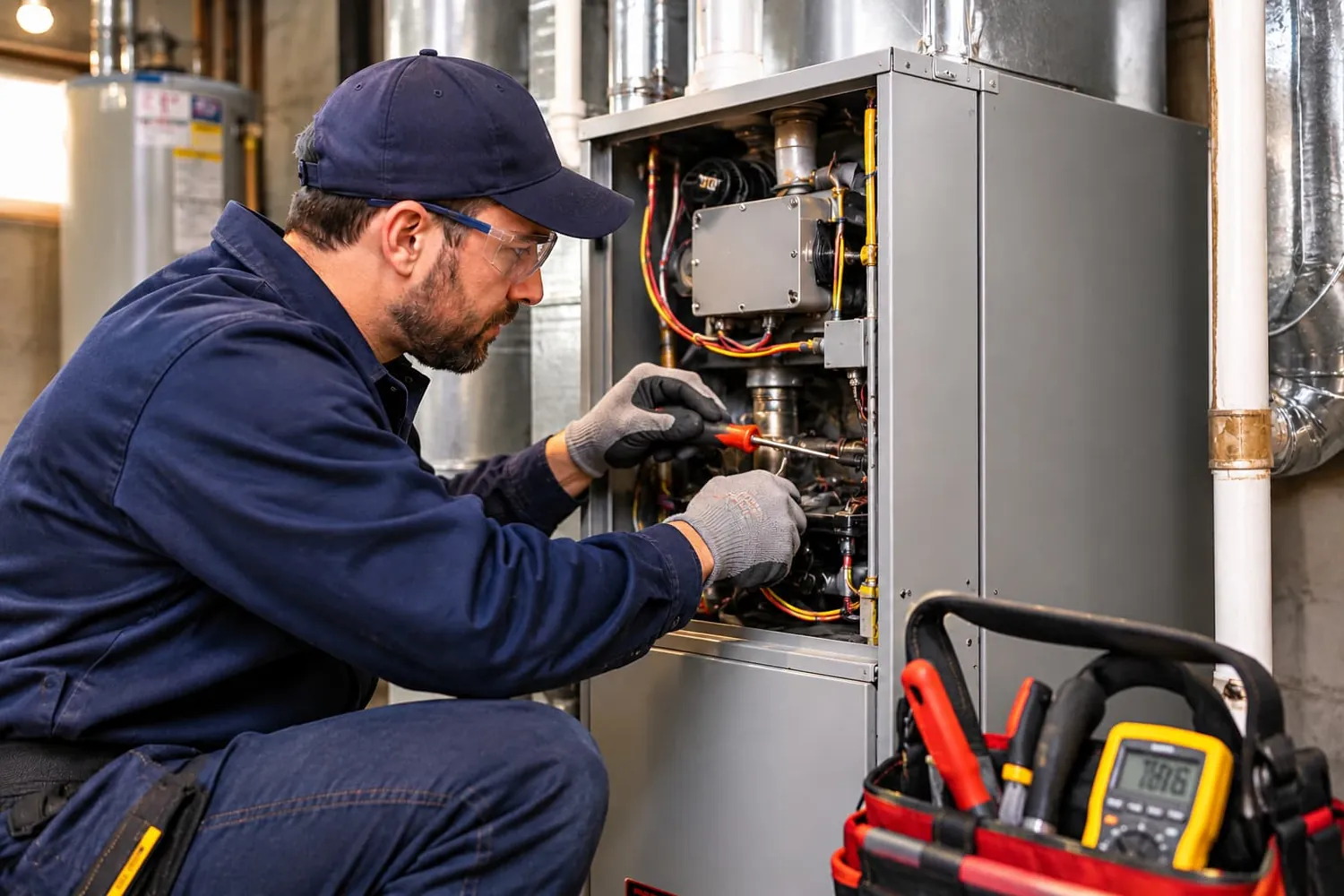
A complete furnace inspection can look at the air filter, blower assembly, motor and capacitor, belts on applicable older systems, burners, ignition components, vent connector, gas controls, thermostat wiring, and accessible ducts. For a condensing furnace, the condensate collector, trap, drain, and PVC intake and exhaust are also part of normal operation. The equipment manual and model number guide testing because component layouts vary by manufacturer and furnace efficiency level.
Furnace repair work in Littleton
| Part | What it does | Signs it is failing |
|---|---|---|
| Air filter | Catches dust before air enters the furnace. | Weak airflow, frequent cycling, or a visibly dirty filter. |
| Thermostat | Signals the furnace when the home needs heat. | The furnace does not start, runs at the wrong time, or does not reach the set temperature. |
| Igniter | Starts the burner ignition sequence. | The blower runs but the burners do not light. |
| Flame sensor | Confirms that a burner flame is present. | Burners light briefly, then shut off. |
| Blower motor | Moves heated air through the duct system. | Little airflow, loud operation, or a blower that does not start. |
Littleton winter conditions and furnace operation
Littleton's Front Range location brings cold weather, snow, sunshine, dry air, and changing temperatures during the heating season. A home can warm quickly in direct sun but cool rapidly after sunset, particularly where insulation or air sealing is limited. Foothill winds can add to heat loss in west and southwest Littleton neighborhoods. Checking filters regularly and keeping furnace vent terminals free of snow and debris supports safe airflow and combustion.
Where we work in Littleton
Also nearby: Englewood, Sheridan, Centennial, Highlands Ranch, Bow Mar, Columbine Valley, Greenwood Village.
Downtown Littleton
Older housing and remodeled properties may have furnace and duct upgrades from several different periods.
Ken Caryl
Foothill-adjacent homes can experience wind exposure and temperature variation across multi-level floor plans.
Roxborough
Homes near the foothills may rely on balanced duct airflow and effective weather sealing during cold weather.
Grant Ranch
Suburban homes in this area commonly use central forced-air heating with basement or utility-room equipment.
Columbine Valley
Larger homes and additions can have multiple heating zones or longer duct runs to distant rooms.
Littleton furnace questions
What ZIP codes are associated with Littleton furnace repair?
Littleton addresses commonly use 80120, 80121, 80122, 80123, 80125, 80127, and 80128. Some of these ZIP codes also cover nearby communities or unincorporated areas.
Why does my furnace shut off before the house reaches the thermostat setting?
The unit may be overheating because of restricted airflow, or it may have an ignition, flame-sensing, limit-switch, or thermostat-related issue. The pattern of lights, sounds, and blower operation helps identify the cause.
Can a finished basement affect furnace performance?
A finished basement can change airflow needs if supply and return ducts were not adjusted for the added space. Closing off rooms or altering return paths can also affect circulation through the rest of the home.
What does a furnace pressure switch do?
A pressure switch confirms that the inducer and venting system are moving combustion gases as expected before ignition. A vent blockage, condensate issue, cracked tubing, or inducer problem can prevent it from closing.
Should furnace vents be checked after a snowstorm?
Exterior intake and exhaust pipes on high-efficiency systems should remain clear of snow and ice. Do not modify the venting; remove only loose obstruction if it can be done safely and contact a qualified professional if the furnace will not operate.
Need furnace repair in Littleton?
Tell us your town and what is happening.