Furnace repair in Louisville, CO
Furnace repair guidance for homes and businesses in Louisville, Colorado.
Furnace Repair
TownLouisville, CO
CountyBoulder
ZIP80027
- 5years of experience
- 2,000+customers served
- 15team members
- 4.9/5from 345 Google reviews
Heating concerns in Louisville’s established neighborhoods and newer developments
Louisville sits in southeastern Boulder County between Boulder and the Denver metro area. Older homes near Old Town Louisville stand alongside newer subdivisions in areas such as Steel Ranch and Coal Creek Ranch. Many local properties use forced-air gas furnaces, with equipment installed in basements, utility rooms, garages, attics, or mechanical closets. The mix of housing ages means heating systems can range from older standing-pilot furnaces to high-efficiency condensing equipment.
Older housing near Old Town
Homes near downtown Louisville may have older duct layouts, later additions, and mechanical equipment installed during renovations. Furnace replacement or repair planning often starts with checking the age and condition of the venting, return-air path, and thermostat wiring.
Newer planned neighborhoods
Newer homes in Steel Ranch, Coal Creek Ranch, and other planned areas commonly have sealed combustion furnaces and insulated duct systems. Even newer equipment can develop ignition, pressure-switch, condensate, or airflow problems.
Front Range wind and temperature changes
Louisville can see rapid weather changes along the Front Range. A furnace that is marginally sized, has a dirty filter, or has restricted airflow may run longer during a cold snap.
Dry indoor winter air
Winter heating lowers indoor humidity in many Colorado homes. Dry conditions do not usually cause a furnace failure, but they can make uneven temperatures and airflow problems more noticeable.
How furnace repair is approached in Louisville homes
Many Louisville residences have natural-gas forced-air heating with a thermostat, blower compartment, filter rack, supply ducts, return ducts, and exterior venting. Older conventional furnaces may use a metal flue, while condensing furnaces use PVC intake and exhaust piping along with a condensate drain. Heat pumps and dual-fuel systems are also present in some newer homes. Identifying the equipment type is important before diagnosing a no-heat condition.
Common furnace trouble includes a system that starts but does not ignite, a blower that runs without delivering warm air, short cycling, loud operation, or rooms that do not heat evenly. Dirty filters, failed igniters, flame-sensor buildup, limit-switch trips, thermostat faults, worn blower motors, and blocked condensate lines can contribute to these symptoms. A furnace may also shut down when combustion venting or pressure-switch operation is interrupted. Carbon monoxide alarms should be treated seriously, and any alarm or suspected gas odor calls for following local emergency guidance and leaving the area when appropriate.
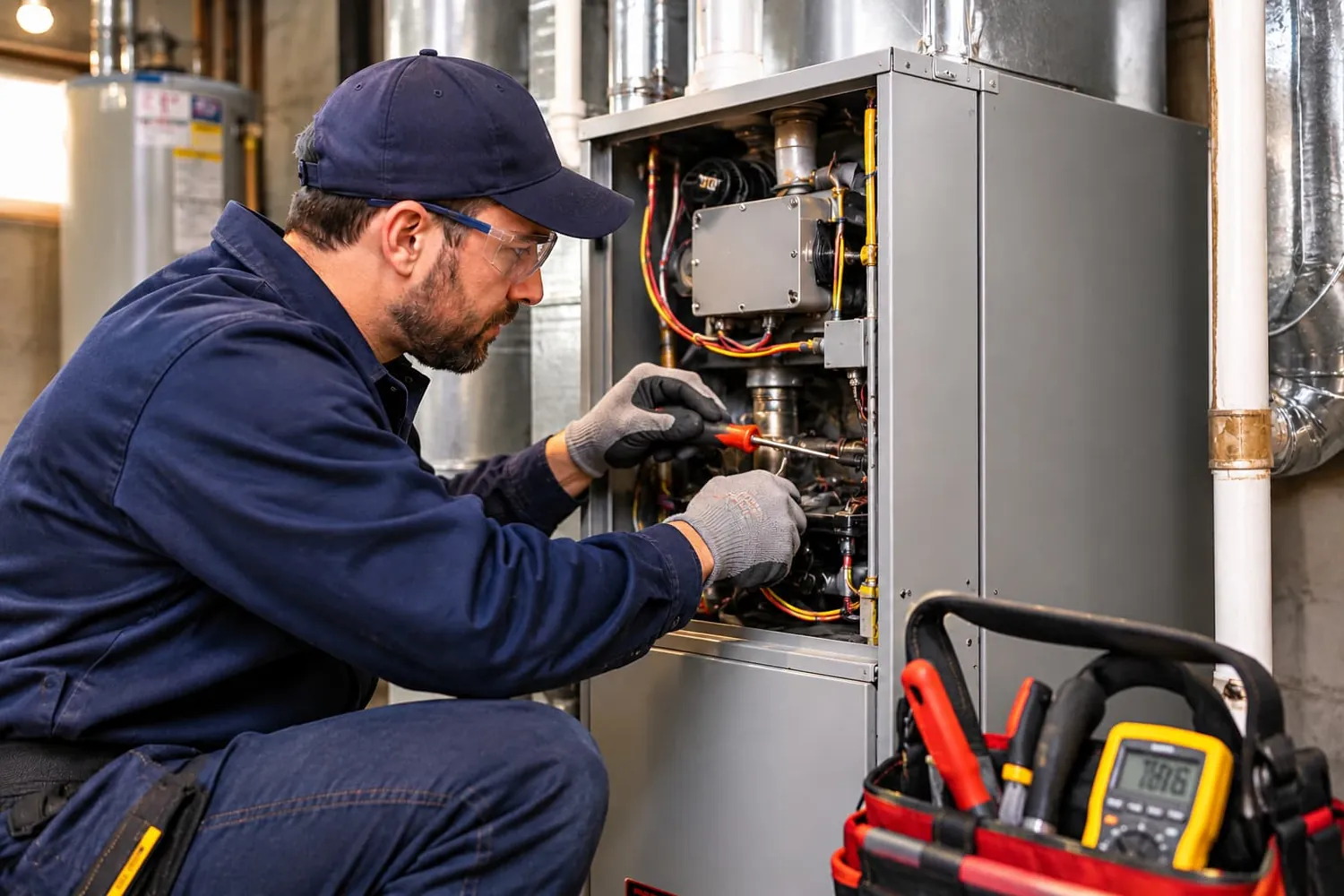
A repair visit generally begins with confirming the thermostat call for heat and checking electrical power, furnace controls, airflow, ignition sequence, and safety switches. The equipment’s filter, blower assembly, burners, heat exchanger area, venting connections, condensate components, and duct connections may need inspection depending on the furnace design. Technicians use manufacturer fault codes and meter readings to narrow down an electrical or mechanical problem. Regular filter changes and seasonal inspection can help reveal wear before the colder part of the heating season.
Furnace repair work in Louisville
| Part | What it does | Signs it is failing |
|---|---|---|
| Air filter | Catches dust before air enters the furnace. | Weak airflow, frequent cycling, or a visibly dirty filter. |
| Thermostat | Signals the furnace when the home needs heat. | The furnace does not start, runs at the wrong time, or does not reach the set temperature. |
| Igniter | Starts the burner ignition sequence. | The blower runs but the burners do not light. |
| Flame sensor | Confirms that a burner flame is present. | Burners light briefly, then shut off. |
| Blower motor | Moves heated air through the duct system. | Little airflow, loud operation, or a blower that does not start. |
Louisville weather and the heating season
Louisville’s semi-arid Front Range climate brings cold winter nights, periodic snow, and large shifts between daytime and nighttime temperatures. Heating equipment may cycle frequently during cold spells, especially when wind adds heat loss around doors, windows, and attic penetrations. Spring and fall can alternate quickly between mild and cold weather, making a furnace problem easier to miss until a stronger cold front arrives. Keeping outside intake and exhaust terminations clear of snow, leaves, and windblown debris is relevant for high-efficiency furnaces.
Where we work in Louisville
Also nearby: Lafayette, Superior, Boulder, Broomfield, Erie, Arvada.
Old Town Louisville
Older homes and renovated properties may have a mix of original and updated ductwork or venting.
Coal Creek Ranch
Many homes here have central forced-air systems serving multiple levels.
Steel Ranch
Newer construction may use high-efficiency furnaces with condensate drainage and PVC venting.
Centennial Valley
Two-story layouts can make return-air balance and upper-floor comfort important.
Cherrywood
Homeowners may notice furnace airflow differences between interior rooms and perimeter rooms.
Heritage
Properties in this area include established homes with heating equipment of varying ages.
Louisville furnace questions
What ZIP code is used for furnace repair requests in Louisville?
Louisville uses ZIP code 80027. Providing the street address helps identify the property location and equipment access details.
Why does my Louisville furnace start and then shut off?
Short cycling can be related to a dirty filter, overheating, a limit switch, thermostat placement, or an ignition-related safety shutdown. The exact cause depends on the furnace sequence and any diagnostic code shown on the control board.
What should I check before scheduling furnace diagnosis?
Confirm that the thermostat is set to heat and that its temperature setting is above the room temperature. Check the furnace switch, electrical breaker, and filter, but do not bypass safety controls or remove sealed combustion parts.
Do high-efficiency furnaces need a condensate drain check?
Yes. Condensing furnaces produce water during operation, and the drain tubing, trap, or pump can become restricted. A blocked condensate path can trigger a safety shutdown on some systems.
Why are some rooms colder than others in a Louisville house?
Uneven heating can involve duct design, return-air capacity, closed registers, insulation levels, window exposure, or a blower setting. Furnace operation should be checked along with the distribution system rather than assuming the furnace alone is the cause.
Need furnace repair in Louisville?
Tell us your town and what is happening.