Furnace repair in Westminster, CO
Keep Westminster furnace problems from turning into a cold-house issue.
Furnace Repair
TownWestminster, CO
CountyAdams
ZIP80020, 80021, 80030, 80031, 80234
- 5years of experience
- 2,000+customers served
- 15team members
- 4.9/5from 345 Google reviews
Heating systems across Westminster’s older and newer neighborhoods
Westminster spans Adams and Jefferson counties between Denver and Boulder, with many neighborhoods built across several decades. US 36 runs along the city’s western side, while Wadsworth Parkway and Federal Boulevard serve major local corridors. Standley Lake and the city’s extensive open-space system contribute to the area’s exposed Front Range conditions. Housing includes older ranch and split-level homes, townhomes, apartments, and newer subdivisions with different furnace and duct arrangements.
Older ranch and split-level homes
Older Westminster homes may have original duct trunks, undersized returns, or furnaces installed in basements and utility rooms. Airflow imbalance between levels can make thermostat placement and return-air paths important.
Townhomes and shared-wall construction
Townhomes and attached homes often place furnaces in closets, garages, or compact mechanical rooms. Access to filter racks, condensate lines, and vent piping can be tighter than in a detached house.
Open space and lake weather
Areas near Standley Lake and open-space corridors can be exposed to wind, snow, and rapid Front Range weather shifts. Exterior combustion-air and exhaust pipes need room to discharge freely.
Renovated housing
A remodel may add finished basement rooms, replaced windows, or changed interior layouts. Those changes can affect airflow, return grilles, duct runs, and how long the furnace runs to heat each space.
Diagnosing no-heat calls in Westminster
Westminster homes commonly use gas forced-air furnaces with programmable or smart thermostats and central air-conditioning equipment. The furnace and air conditioner often share a blower, evaporator coil, supply ducts, and return ducts. A filter cabinet may be located beside the furnace, behind a return grille, or in a ceiling slot. Identifying the filter location and airflow direction helps avoid installing the filter backward.
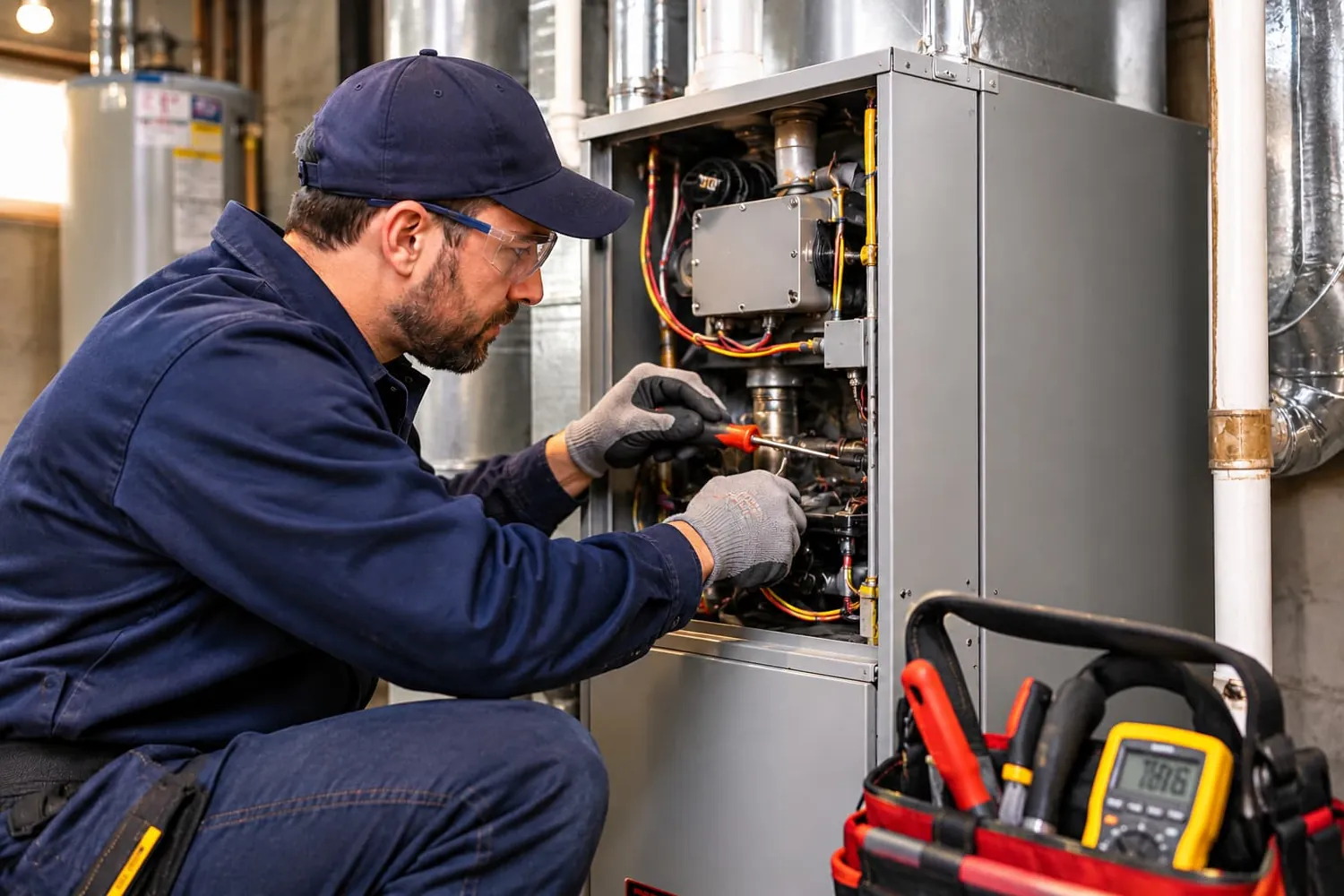
Ignition sequence faults are a frequent reason for a furnace that will not heat. The inducer must run, pressure switches must prove venting, the igniter must operate, and the flame sensor must confirm burner flame. Failure at any stage can cause the board to lock out after several attempts. Error-code lights provide a starting point, although the code must be interpreted with testing rather than assumed to identify one failed part.
Repair diagnosis covers electrical power, thermostat signals, control-board status, safety switches, burners, blower operation, and venting. On condensing furnaces, the condensate trap, tubing, drain slope, and PVC vent pipes are part of the heating system. A blocked drain or frozen exterior termination can interrupt operation. After a repair, temperature rise and cycling behavior can help confirm that airflow and burner operation are within the equipment’s specifications.
Furnace repair work in Westminster
| Part | What it does | Signs it is failing |
|---|---|---|
| Air filter | Catches dust before air enters the furnace. | Weak airflow, frequent cycling, or a visibly dirty filter. |
| Thermostat | Signals the furnace when the home needs heat. | The furnace does not start, runs at the wrong time, or does not reach the set temperature. |
| Igniter | Starts the burner ignition sequence. | The blower runs but the burners do not light. |
| Flame sensor | Confirms that a burner flame is present. | Burners light briefly, then shut off. |
| Blower motor | Moves heated air through the duct system. | Little airflow, loud operation, or a blower that does not start. |
Why Westminster weather matters to furnace operation
Westminster’s Front Range weather brings dry air, cold snaps, snow, wind, and large day-to-night temperature changes. Heating demand can rise quickly when a cold front arrives after mild conditions. Dry indoor air does not cause a furnace failure, but it can make comfort concerns more noticeable and lead residents to adjust thermostats often. Filter checks and clear vent terminations are particularly useful before winter storms.
Where we work in Westminster
Also nearby: Broomfield, Arvada, Northglenn, Federal Heights, Thornton, Denver.
Harris Park
Harris Park has established homes where furnace age, basement ductwork, and return-air capacity can vary from house to house.
Bradburn Village
Bradburn Village includes newer-style residential development where high-efficiency furnaces and PVC venting may be present.
Countryside
Countryside has homes from earlier development periods, making filter access and original duct layouts worth checking.
Westcliff
Westcliff includes residential streets near major Westminster corridors where attached garages and mechanical closets are common.
Sherrelwood
Sherrelwood is in the Adams County portion of the Westminster area, with a mix of older houses and multifamily properties.
Westminster furnace questions
Which Westminster ZIP codes are commonly served by furnace repair searches?
Westminster ZIP codes include 80020, 80021, 80030, 80031, and 80234. Because the city crosses county lines, confirming the full street address is useful when scheduling any service.
Why does my furnace show an error code?
The flashing code on the furnace control board indicates where the heating sequence stopped or which safety circuit opened. The furnace manual can explain the code, but electrical and gas-related diagnosis should be done carefully.
Is a dirty filter enough to stop a furnace?
A heavily loaded filter can reduce airflow and cause the furnace to overheat. The high-limit switch may then shut off the burners, sometimes producing repeated short cycles.
Why are upstairs rooms colder in a Westminster split-level home?
Warm air rises, but duct length, return-air placement, insulation, closed registers, and thermostat location can still create uneven temperatures. Furnace output is only one part of a whole-home airflow issue.
What does a furnace tune-up inspection generally check?
Seasonal inspection commonly includes the filter, burner area, flame sensor, venting, electrical connections, blower compartment, safety controls, and thermostat operation. The exact work depends on the furnace model and its condition.
Need furnace repair in Westminster?
Tell us your town and what is happening.