Furnace repair in Wellington, CO
Furnace repair for Wellington homes facing cold, windy Front Range winters.
Furnace Repair
TownWellington, CO
CountyLarimer
ZIP80549
- 5years of experience
- 2,000+customers served
- 15team members
- 4.9/5from 345 Google reviews
Heating problems in Wellington's fast-growing high-plains community
Wellington sits in northern Larimer County, north of Fort Collins and just east of Interstate 25. The town has older homes near Cleveland Avenue as well as newer development around its edges. Properties range from compact in-town lots to larger lots and rural homes beyond town limits. That mix can mean different furnace locations, duct layouts, fuel arrangements, and access needs.
Wind exposure on open lots
The plains around Wellington are exposed to persistent wind, especially during winter weather changes. Wind can push cold air through poorly sealed doors, attic penetrations, and crawlspace openings, making a heating system run longer.
Older homes near the town center
Older houses can have additions, replacement equipment, and ductwork that has been modified over time. Furnace repair often starts with confirming that airflow, return ducts, venting, and the thermostat work together.
Newer construction
Newer Wellington homes commonly use forced-air systems with programmable or smart thermostats. A no-heat call may involve a control setting, condensate safety switch, flame sensor, pressure switch, or blower problem rather than the thermostat alone.
Rural properties outside town
Homes on acreage may have equipment in garages, utility rooms, basements, or outbuildings. Longer duct runs, dusty conditions, and equipment installed in unconditioned spaces can affect heat delivery and component wear.
What furnace repair involves in Wellington homes
Many homes use a forced-air furnace with a blower, filter rack, return grille, supply registers, thermostat, and metal or flexible ductwork. Gas furnaces use an ignition sequence involving the thermostat call, inducer motor, pressure switch, igniter, gas valve, burners, flame sensor, and circulating blower. A fault at any point in that sequence can leave the house without heat or cause short cycling. Electric furnaces and heat-pump systems have different components and need a different diagnostic path.
Common winter complaints include a furnace that starts but shuts down, a blower that runs with cool air, rooms that stay colder than others, and repeated thermostat adjustments with little change. A dirty flame sensor, blocked filter, failed igniter, worn blower capacitor, limit-switch issue, or drainage problem on a high-efficiency unit can produce similar symptoms. Restricted return air can also cause high-temperature limit trips. The furnace model, fault code, filter condition, venting arrangement, and operating sequence help narrow the cause.
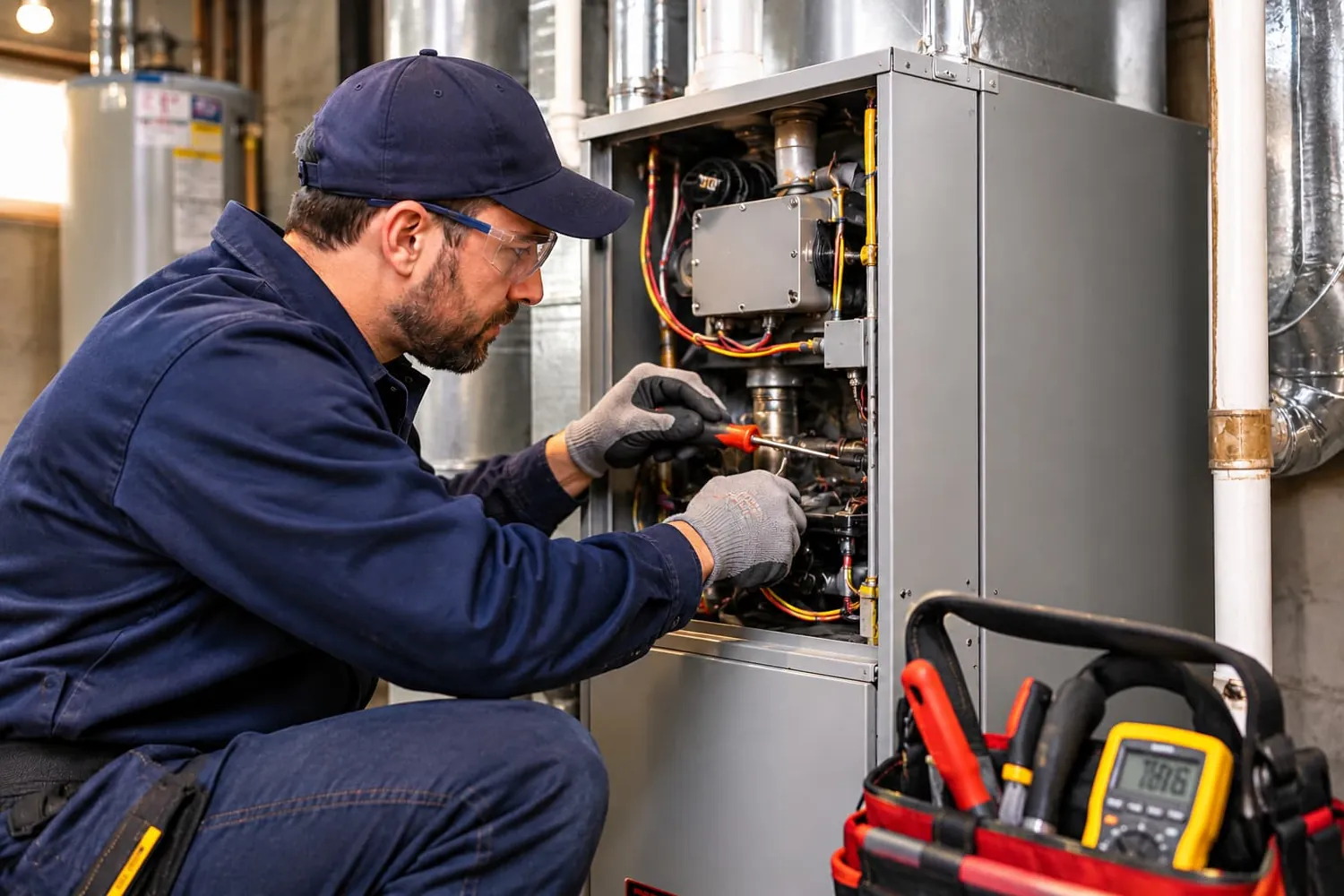
A repair visit begins with the reported symptom and a check of safe operation before parts are considered. The diagnostic work can include checking thermostat signals, power, fuse and breaker status, filter condition, inducer and blower operation, ignition, burner flame, safety controls, condensate drainage, and airflow. The equipment cabinet and accessible duct connections may also be inspected for loose panels or obvious leakage. Keeping the filter size and replacement date handy can help with the visit.
Furnace repair work in Wellington
| Part | What it does | Signs it is failing |
|---|---|---|
| Air filter | Catches dust before air enters the furnace. | Weak airflow, frequent cycling, or a visibly dirty filter. |
| Thermostat | Signals the furnace when the home needs heat. | The furnace does not start, runs at the wrong time, or does not reach the set temperature. |
| Igniter | Starts the burner ignition sequence. | The blower runs but the burners do not light. |
| Flame sensor | Confirms that a burner flame is present. | Burners light briefly, then shut off. |
| Blower motor | Moves heated air through the duct system. | Little airflow, loud operation, or a blower that does not start. |
Why Wellington weather puts heating systems to work
Wellington has a semi-arid Front Range climate with cold winters, quick temperature shifts, snow, and strong wind. A mild afternoon can be followed by a much colder night, which changes how long a furnace must operate. Dry air does not directly cause a furnace failure, but it can make indoor comfort problems more noticeable when airflow is uneven. Before the heating season, a clean filter and clear outdoor intake and exhaust terminations are practical items to check.
Downtown Wellington
Older in-town houses may have replacement furnaces and ductwork added during past renovations.
Cleveland Avenue corridor
Homes along this central route include established properties where return-air capacity and vent routing can vary.
Wellington Community Park area
Residential streets near the park include a mix of home ages and typical forced-air heating layouts.
Interstate 25 interchange area
Newer homes and commercial-adjacent buildings near I-25 may have modern high-efficiency equipment and condensate drains.
Wellington furnace questions
What ZIP code is used for Wellington furnace repair?
Wellington's ZIP code is 80549. Addresses outside the town boundary can use different mailing designations, so the service address is important when scheduling.
Why does my Wellington furnace run but blow cool air?
The blower can operate even when the burners have not stayed lit. The cause may involve ignition, flame sensing, a safety switch, fuel supply, or the control board, and diagnosis should follow the furnace sequence.
Can wind affect a furnace in Wellington?
Wind can increase heat loss from a house and expose problems with air sealing around the building. It can also make clear, correctly installed combustion-air and vent terminations especially important on applicable equipment.
Why are some rooms colder than the rest of the house?
Uneven rooms can result from duct leakage, a closed or obstructed register, insufficient return air, insulation differences, or thermostat location. The furnace may be operating normally while the air-distribution system needs attention.
What should I check before arranging a repair?
Confirm that the thermostat is set to heat, the filter is not heavily loaded, and accessible supply registers are open. Do not bypass furnace safety switches or repeatedly reset a breaker that trips.
Need furnace repair in Wellington?
Tell us your town and what is happening.